
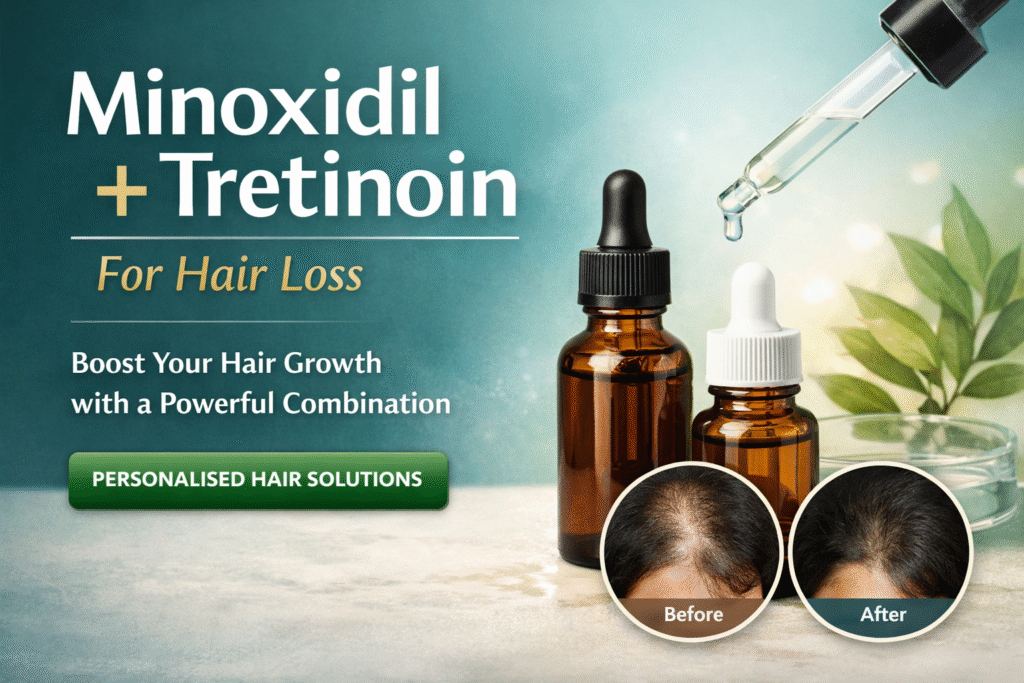
Minoxidil with Tretinoin for Hair Loss. Why This Combination Can Improve Results
Hair loss treatments have evolved significantly over the past decade. While minoxidil remains one of the most widely used topical therapies for hair regrowth, many clinicians and hair specialists now combine it with tretinoin to enhance absorption and improve outcomes.
At Root & Radiance, we believe personalised treatment matters. Different people respond differently to topical therapy, which is why customised formulations can play an important role in a more tailored approach to hair loss treatment.
In this article, we explain how minoxidil works, why tretinoin may improve its effectiveness, who may benefit from this combination, and how personalised formulations can help support better outcomes.
Looking for a personalised hair loss formula?
Build your treatment based on your needs, goals, and preferred active ingredients using our online Hair Customiser.
What Is Minoxidil?
Minoxidil is a topical medication widely used to treat androgenetic alopecia, also known as male or female pattern hair loss.
It works through several mechanisms:
1. Increased blood flow to hair follicles
Minoxidil widens blood vessels around the follicle, which may help improve oxygen and nutrient delivery to the scalp.
2. Prolonging the growth phase of hair
Hair follicles cycle through growth, transition, and resting phases. Minoxidil helps keep follicles in the growth phase for longer.
3. Supporting follicular activity
Over time, dormant or miniaturised follicles may begin producing thicker, more visible hairs.
Most commercially available products contain 2% or 5% minoxidil, but in some cases specialist prescribers may consider higher strength compounded formulations where appropriate.
What Is Tretinoin?
Tretinoin is a vitamin A derivative commonly used in dermatology. It is widely known for its role in acne, pigmentation, and skin renewal, but it can also have a useful place in certain topical hair loss formulations.
Tretinoin may help by:
- Increasing skin cell turnover
- Improving penetration of topical medications
- Supporting a healthier scalp environment
- Enhancing delivery of active ingredients to the follicular area
When used alongside minoxidil, tretinoin may help improve how effectively the treatment reaches the scalp and hair follicles.
Why Combine Minoxidil with Tretinoin?
There is growing interest in the use of minoxidil with tretinoin hair solutions because this combination may offer advantages over standard minoxidil alone in some individuals.
Improved absorption
One of the main reasons clinicians may explore this combination is that tretinoin can increase turnover in the outer layer of the skin. This may help improve penetration of minoxidil into the scalp.
Potential support for minoxidil activity
Minoxidil needs to be converted into its active form within the scalp. Some evidence suggests tretinoin may help support this process, which may be particularly relevant for those who have not responded well to standard minoxidil alone.
A more advanced topical approach
Patients searching for a tretinoin minoxidil solution for hair loss are often looking for something more tailored than a standard off-the-shelf product. Combination therapy can form part of a more personalised regimen, especially when scalp sensitivity, treatment response, and hair loss pattern are all taken into account.
Who Might Benefit from Minoxidil and Tretinoin?
This type of formulation may be considered for people who:
- Have androgenetic alopecia
- Have not had the desired response to minoxidil alone
- Want a more personalised topical treatment approach
- Need a tailored formula based on scalp sensitivity or treatment goals
Depending on the clinical pathway, other actives may also be considered in customised hair formulations, including ingredients such as finasteride, dutasteride, caffeine, melatonin, or latanoprost.
Why Personalised Hair Loss Treatments Matter
Hair loss is highly individual. The ideal treatment for one person may not be suitable for another.
Different people may require different:
- Ingredient combinations
- Strengths
- Formulation bases
- Application routines
Factors such as scalp sensitivity, previous treatment response, hair loss pattern, and personal preference can all affect which formulation is most appropriate.
That is why personalised compounding can be so valuable. It allows a more tailored route rather than relying on one standard formulation for everyone.
Potential Side Effects of Minoxidil with Tretinoin
As with any topical treatment, side effects are possible. These may include:
- Scalp irritation
- Redness
- Dryness
- Mild peeling
- Temporary increased shedding early in treatment
Using the correct formulation base and carefully selected strengths may help reduce irritation. Suitability should always be assessed on an individual basis.
When Will You See Results?
Hair growth treatment takes time, and consistency is important.
Around 3 months
Some people begin to notice reduced shedding.
Around 4 to 6 months
Visible changes in density may begin to develop.
Around 9 to 12 months
Longer-term results are usually assessed over a sustained period of regular treatment.
Changing products too soon or missing applications can reduce the likelihood of seeing optimal benefit.
Create Your Personalised Hair Formula
At Root & Radiance, we offer a more personalised route to hair care. Depending on your chosen pathway, customised formulations may include ingredients such as minoxidil, tretinoin, finasteride, dutasteride, caffeine, and more.
Use our Hair Customiser to build a treatment that reflects your needs and preferences.
Frequently Asked Questions
Can tretinoin make minoxidil work better?
Tretinoin may help improve penetration of minoxidil into the scalp and may support its activity in some individuals. This is one reason the combination is often explored in more advanced topical hair loss formulations.
Is minoxidil with tretinoin suitable for everyone?
Not always. Suitability depends on factors such as scalp sensitivity, hair loss type, previous treatment response, and the wider clinical picture. Personalised assessment is important before starting treatment.
How long does minoxidil with tretinoin take to show results?
Hair loss treatments usually take several months to assess properly. Some people notice reduced shedding after around 3 months, while more visible density changes may take 4 to 6 months or longer.
Can I customise my hair loss treatment online?
Yes. Root & Radiance offers an online Hair Customiser that allows you to explore a more tailored route to treatment based on your needs and preferences.
Why choose a personalised hair solution instead of a standard product?
Personalised solutions allow for more flexibility in ingredient selection, strength, and formulation base. This can be particularly useful when standard products have not been well tolerated or have not delivered the desired results.
Final Thoughts
Using minoxidil with tretinoin for hair loss is becoming an increasingly popular option for those seeking a more tailored topical treatment plan. By potentially improving penetration and supporting a healthier scalp environment, this combination may offer benefits for some individuals compared with standard minoxidil alone.
Because every case of hair loss is different, a personalised treatment route is often the most sensible place to start.
Disclaimer
This content is for general informational purposes only and does not constitute medical advice. Treatment suitability varies between individuals. Always follow guidance provided during your clinical assessment and prescribed treatment plan.